An estimated 86 million users in France, Germany and Italy would leave dominant social media platforms for viable alternatives
- New YouGov survey commissioned by Data Rights analyses the leaving intentions as well as motivators and main barriers across users of so-called ‘gatekeeper’ social media platforms in three European countries
- The survey finds a third of French, Germans, and Italians open to leaving LinkedIn and TikTok for viable alternatives
- Gatekeeper platforms are designated as such under the EU Digital Markets Act (DMA) due to their vast user numbers in Europe and span social networking, media, shopping and navigation platforms
- Findings come after the European Union examined the effectiveness of the Digital Markets Act and decided against expanding key requirements that would increase the agency of users due to a lack of demand
- The survey was weighted to be nationally representative across France, Germany and Italy
LinkedIn and TikTok are topping the list of social media platforms across three European countries with the highest intentions of leaving amongst users, according to our survey published today.
Across the four social networking services designated under the DMA, around one in four (Facebook and Instagram) to one in three (LinkedIn and Tiktok) users want to move to an alternative platform that is more aligned with their needs and values.

Question we asked: “Imagine that an alternative option exists for each of the following platforms and digital services, and that you could transition to an alternative better aligned with your needs and values, without losing data, connections, and the ability to connect to people on the original service. How likely would you be to stay or leave the following platforms and services? Please select one answer per platform/digital service.”
Considering Facebook and its roughly 110 million average monthly active users in these three countries, this constitutes 27.5 million people willing to leave the platform for a better alternative. TikTok similarly has an estimated 21 million users willing to leave, based on a total of 63.1 million users in the three countries studied. Based on 121 million Instagram users, 27.9 million would be willing to leave. For LinkedIn it is an estimated 9.6 million users, based on 26 million total.
"Consumers are facing increasing enshittification of online services they use, and many have had enough. They want out but do not want to lose their connections. We urgently need to build bridges to alternatives."

Social Lock-In and a lack of alternatives as key barriers
For Facebook (26%) and Instagram (23%) users who expressed an interest in leaving the platform, the fear of losing connections with other users or friends and family is the main reason for staying.

Many users were not able to identify any clear barriers.
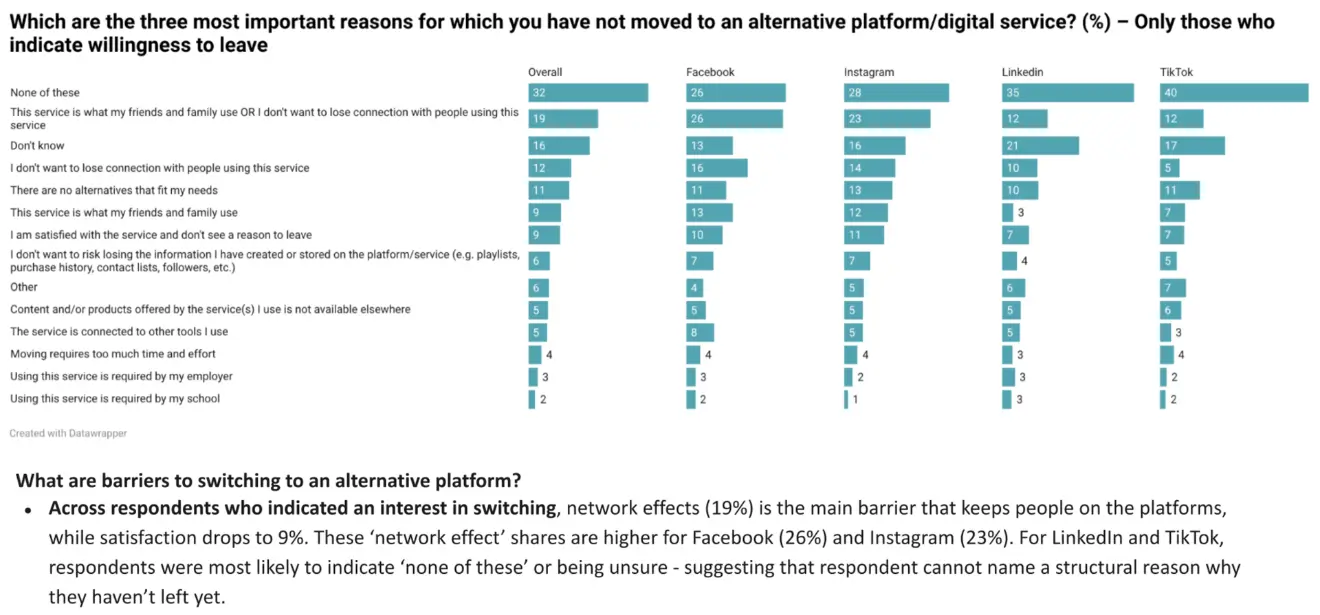
While this mostly highlights the need for more granular research, this finding might point to a lack of prior consideration from users.
Digital Markets Act as a way to strengthen user agency and tackle lock-in
The Digital Markets Act sets out to tackle abusive market practices from gatekeeper services, but when it comes to social media, nothing currently addresses the social lock-in that keeps users from switching platforms.
For messaging services, the Digital Markets Act identifies the ‘network effect’ as a key contributor to user lock-in. It addresses this issue with Article 7, requiring those services to open themselves up for interoperability with third party applications. The survey data shows that similar effects are at play for social media platforms Facebook and Instagram.
Earlier this year, the European Commission published its first review of the DMA in which it concluded that there was no need to extend the interoperability obligations currently imposed on messaging services to online social networking services. The report stated that "demand for such horizontal interoperability from both end and business users was limited".
"This calls into question the Commission’s latest conclusions on interoperability. Facebook was once able to grow because it was interoperable with the then-dominant player, Myspace, allowing users to switch while staying connected. Today people across Europe have expressed a willingness to move to alternative social media but aren't offered the same option. If Europe is serious in its desire to challenge the dominance of ‘gatekeeper’ social media platforms, extending Article 7 to social media platforms is the best way to break down the walls that keep users locked in."

Ethical concerns are the top motivator for users with switching intentions
For every 1 in 2 people (50%), dissatisfaction with the service quality is the primary motivator to leave a platform. Ethical concerns, such as disagreement with the companies' policies or actions outside of the service, rank second and third (both 28%).
Survey Methodology
The poll was organised and directed by Data Rights and conducted by YouGov between the 10th and 17th March 2026. Total sample size was 5121 adults: 1,021 in France, 2062 in Germany and 1031 in Italy, resulting in a theoretical error rate of 1.53% for the total sample.
Data are weighted to be nationally representative of adults (aged 18+) in each of the countries.
All the social media platforms included in the survey are designated as Core Platform Services under the Digital Markets Act.
Complete survey results can be found here.
Glossary
Gatekeepers: Large digital platforms that provide core platform services with significant impact on the European market and enjoy an entrenched and durable position in their operations. The European Commission has designated 7 Gatekeepers and 23 Core Platform Services falling under 8 categories.
Social media services (DMA definition): A platform that enables end users to connect and communicate with each other, share content and discover other users and content across multiple devices and, in particular, via chats, posts, videos and recommendations. LinkedIn, TikTok, Facebook and Instagram are the four social media platforms designated by the European Commission under the DMA.
Messaging services (Electronic Communications Code Directive definition): Interpersonal communications service which does not connect with publicly assigned numbering resources, namely, a number or numbers in national or international numbering plans, or which does not enable communication with a number or numbers in national or international numbering plans; WhatsApp and Messenger are the two messaging services designated by the European Commission under the DMA.
Interoperability (DMA definition): Ability to exchange information and mutually use the information which has been exchanged through interfaces or other solutions. Interoperable services rely on the same protocols used by different actors. Emails are an interoperable technology: Gmail users can exchange with ProtonMail users. Article 7 of the DMA requires interoperability from designated messaging services.